
If you’re curious about programmatic SEO, you’re not alone. It’s one of the most talked-about approaches for scaling SEO efficiently. In this guide, you’ll learn what programmatic SEO means, how it can help you create hundreds (or thousands) of targeted pages, and the steps you need to get started—even if you’re not a tech expert. We’ll also walk through the best tools, real-world examples, and common pitfalls so you can decide if programmatic SEO is the right fit for your website or business.
Understanding programmatic seo
What is programmatic seo?
Programmatic SEO, often called pSEO, is all about using automation and data to create a large number of SEO-optimized pages quickly and efficiently. Unlike traditional SEO, where each page is crafted by hand, programmatic SEO relies on templates and structured data to generate content at scale. This approach is especially useful for targeting long-tail keywords and building dynamic landing pages, making it a go-to strategy for businesses that want to increase their reach without manually writing every single page. In short, programmatic SEO is unique because it blends automation, scalability, and data-driven content creation to help you grow traffic faster with less manual effort.

How does programmatic seo work?
The core process of programmatic SEO starts with collecting data—think product specs, location details, or service features. Next, you build templates that turn these data points into user-friendly, SEO-optimized pages. Automation tools then take over, generating hundreds or thousands of pages by mixing your templates with your data sources. For example, a travel site might use programmatic SEO to create a unique page for every city and activity combination.
This workflow—data collection, template creation, and automated publishing—makes programmatic SEO a powerful approach for bulk content creation and data-driven SEO strategies.
Who should use programmatic seo?
Programmatic SEO is a great fit for publishers, SaaS companies, e-commerce stores, and niche websites that need to build out lots of landing pages. If your business relies on scalable SEO strategies to attract new customers or users, programmatic SEO can help you cover more ground with less manual work. Even small businesses can benefit, especially if they’re targeting local markets or long-tail keywords. However, the best results come when you have a clear structure for your content and access to reliable data sources.
Benefits and risks of programmatic seo
Key advantages
The main advantage of programmatic SEO is efficiency. You can save hours of manual labor by automating repetitive content creation tasks. This lets you target a wider range of long-tail keywords, reach new audiences, and improve your site’s visibility in Google. Compared to traditional, manual SEO, programmatic approaches are faster, more scalable, and give you a competitive edge—especially in markets where speed and breadth matter.
- Save time by automating content creation
- Scale up quickly to cover more search queries
- Target niche audiences with dynamic landing pages
- Boost your site’s visibility and traffic with data-driven pages
Potential risks and challenges
While programmatic SEO is powerful, it’s not without its risks. If you’re not careful, you could end up with duplicate content, thin pages that don’t add value, or even face Google penalties for low-quality bulk content. Quality control is essential—each page needs to offer real value to the user. Technical hurdles, like managing large data sets or building templates, can also be a challenge if you don’t have the right skills or tools. To avoid these pitfalls, focus on quality over quantity and regularly audit your automated pages.
- Duplicate or low-value content can hurt rankings
- Technical setup may require some learning
- Google penalties if automation leads to poor user experience
When not to use programmatic seo
Programmatic SEO isn’t right for every situation. If your niche demands highly personalized or in-depth content, or if you don’t have access to structured data, it might not be a good fit. It’s also less suitable for sites where quality, not quantity, is the main goal. Make sure your technical setup and resources match the scale and complexity of your programmatic SEO plans.
How to implement programmatic seo: step-by-step
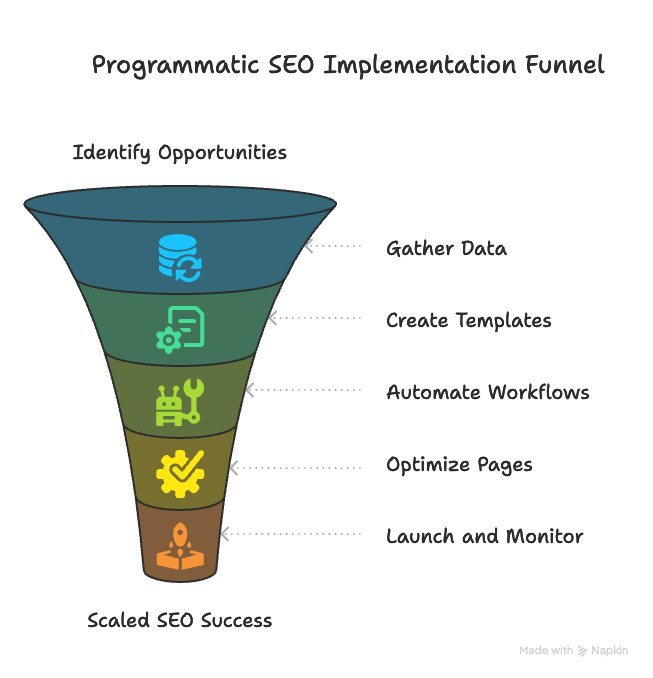
Step 1: Identify opportunities and data sources
Start by spotting areas where programmatic SEO can make the biggest impact. This usually means finding long-tail keywords that your competitors haven’t covered and gathering structured data—like location lists, product attributes, or service features. Keyword research is key here. You’ll want to map out all the possible combinations that users might search for. For a deeper dive into keyword research and content strategy, check out our guide on SEO content writing.
Step 2: Create templates and automation workflows
Next, design content templates that can turn your raw data into useful, readable web pages. These templates should include SEO best practices: clear headings, relevant keywords, and internal linking structures. Then, set up automation workflows using SEO automation tools. Tools like Zapier, Airtable, or custom scripts can help you merge your templates with your data, automatically generating dynamic landing pages at scale. This step is where programmatic SEO truly shines—letting you publish bulk content without losing consistency or quality.
Step 3: Optimize and launch
Before you go live, optimize your generated pages for on-page SEO. That means checking metadata, making sure internal links are in place, and running quality checks to catch any errors or thin content. Keep an eye on performance after launch—monitor traffic, rankings, and user engagement to ensure your pages are delivering value. The goal is to achieve SEO at scale without sacrificing user experience or quality.
Best tools and platforms for programmatic seo
Popular tools and software
Several tools make programmatic SEO much easier. Ahrefs is great for keyword research and competitor analysis, while Zapier can automate workflows between your data sources and CMS. Airtable is popular for managing structured data, and Webflow or WordPress plugins can help build dynamic landing pages. Each tool has its strengths—some focus on data handling, others on automation or content management. When comparing tools, look at features, pricing, and how well they fit with your existing tech stack.
Comparatif des meilleurs outils pour le programmatic SEO
| Tool | Key features | Advantages | Disadvantages | Base price |
|---|---|---|---|---|
| Ahrefs | Keyword research, competitor analysis, rank tracking | Very complete database, intuitive interface | High cost, no native automation | ~99$/month |
| Zapier | Workflow automation, integration of multiple apps | Very flexible, easy to connect to other tools | Limited on large volumes without a paid plan | Free, then starting at $19.99/month |
| Airtable | Structured data management, team collaboration | Visual interface, powerful API | May require scripts for automation | Free, then starting at $10/month |
| Webflow | Dynamic page creation, visual CMS | No technical skills required, advanced design | Learning curve for advanced features | Free, then starting at $14/month |
| WordPress + plugins | Page creation, automation plugins (WP All Import, etc.) | Rich ecosystem, highly customizable | May require technical skills for automation | Free (paid hosting and plugins) |
- Ahrefs: Research keywords, track rankings
- Zapier: Automate content workflows
- Airtable: Organize and manage data
- Webflow/WordPress: Build and publish dynamic landing pages
Choosing the right solution for your needs
Think about your business size, budget, and technical skills when picking a programmatic SEO tool. Small teams might prefer simple, all-in-one platforms, while larger businesses may want more customizable solutions. Look for tools that are easy to use, can scale with your needs, and offer good support when you hit a snag. It’s worth testing a few options before committing, so you find the best fit for your workflow and goals.
Real-world examples and case studies
Successful programmatic seo in action
Plenty of companies have grown their traffic with programmatic SEO. For example, SaaS companies often use it to create pages for every possible software integration or feature combination. Publishers might generate city or topic-specific guides, while e-commerce stores can build category and product attribute pages at scale. One case study showed a niche site that saw a 300% increase in organic traffic after rolling out dynamic, data-driven landing pages for every location they served. These examples prove that, when done right, programmatic SEO can drive real results.
Lessons learned and best practices
What sets successful programmatic SEO apart is a focus on quality. Always prioritize user value over sheer volume. Avoid duplicate or thin content, and regularly update your data sources to keep pages fresh. Industry experts also recommend starting small, testing your approach, and scaling up once you’re confident in your templates and automation. Here are a few quick tips:
- Test templates on a small batch of pages first
- Regularly audit for duplicate or low-quality content
- Keep user intent and readability front and center
- Monitor performance and adjust your workflow as needed
FAQs about programmatic seo
What is programmatic SEO and how does it work?
Programmatic SEO uses automation and templates to generate large numbers of SEO-optimized pages based on structured data. It’s ideal for targeting long-tail keywords and scaling up your site quickly, but it requires careful planning to avoid quality issues.
What are the best tools for programmatic SEO?
Top tools include Ahrefs for keyword research, Zapier for workflow automation, Airtable for managing data, and website builders like Webflow or WordPress for dynamic page creation. The best choice depends on your needs and technical skills.
Are there risks or downsides to programmatic SEO?
Yes—risks include duplicate content, thin pages, and potential Google penalties if quality isn’t maintained. To avoid problems, focus on user value, check your content regularly, and start with a manageable number of pages.
Share this article